
Beyond the flesh: the body as a pressurized architecture
To the eye, the human body is an assembly of flesh, blood, bone, and busy organs - a biological machine that runs on food and the mechanical bellows of the lungs. That description is true, and for most of a life it is enough. But there is a point in serious practice, well past the place where asana is exercise, where the body stops behaving like an anatomy diagram and starts revealing itself as something else: a tall, pressurized, multi-chambered geometry of fluid columns, hydraulic pumps, and vertical centers of charge.
The Nath Sampradaya - the lineage of Adinath, Matsyendranath, and Gorakshanath - mapped that geometry through the architecture of the Lingam, the egg, the pillar of light. In their reading the body is not one thing. It is a stack of inner Lingams (Sukshma Lingas) flanked by peripheral gates. When the gates stand open, the life-force leaks outward all day long - dissipating as restless heat, emotional weather, and the endless friction of an erratic breath. When the gates are sealed by the precise mechanical locks of Hatha Yoga - binding the limbs, isolating the channels, sealing the upper vault with Khechari, and compressing the trunk - the leakage stops. The whole multi-axis geometry collapses inward onto a single vertical line, and what is normally spent outward is driven up the center instead.
This post is a map of that inward collapse, and of what waits at the end of it: the moment the three inner Lingams line up with no friction between them, the central channel flashes into full conduction, and the spine rings with the Anahata Nada - the unstruck sound, the booming resonance the tradition names Aum. It is also a record of three places where that conduction arrived for me with unmistakable force - the Sanjeevan Samadhi at Alandi, the crown-vortex of the Velliangiri Seventh Hill, and the vertical granite spine of Girnar.
The first sections are written for beginners who have only ever met yoga as posture and stretch. The middle is for those already steady in the bandhas and retention. The final sections describe the deep machinery for sadhaks who already taste suspension and want a frame for what is moving inside them.
A word before we begin, and it matters here as much as anywhere in this series. Several of the conditions named below - prolonged fasting, single-channel breathing held across great physical exertion, breath driven to suspension - are genuinely dangerous when chased. They were never a curriculum. They arrived as the fruit of years, under conditions I did not engineer on purpose. Read this as a map of a territory, not a set of instructions. The reasons are spelled out plainly in the grounding section near the end, and they are not negotiable.
For beginners: the whole arc in plain language
Before the mechanics, the shape of the thing.
Picture the spine as a tower with three sealed rooms stacked inside it - one in the pelvis, one in the chest, one in the skull. The tradition calls these the Tri-Lingam, the three inner pillars. In an ordinary body they are out of alignment and leaking, each one venting energy sideways into the limbs and outward through the senses. The entire practice in this post is the work of sealing the side-doors, packing pressure into the bottom room, and driving it straight up through the middle and top rooms until all three line up into one open shaft.
The force being driven up has a name: Apana Vayu, the downward, expelling current that governs elimination and everything that falls and leaves the body. Ordinarily Apana sinks. The whole art is to turn it around - to cook it at the navel until it changes state and rushes up instead of down, through the chest, into the head, where it collides with the descending current and rings the central channel like a bell.
So the arc is simple to say, even if it takes years to walk:
Seal the peripheral gates (Siddhasana) → pack and heat the navel (Kanda compression) → invert the downward current (Apana rises) → drive it through the chest piston (T7-T8) → seal and draw it through the skull (C1 and Khechari) → until the three Lingams align and the central channel sounds (the unstruck Aum).
Everything below is that one sentence, slowed down.
The Tri-Lingam: three rooms in the tower
In the foundational verses of the Goraksha Samhita, the body's structure is mapped as a column of inner Lingams seated along the Merudanda, the spinal axis. These are not images to visualize. They are tangible centers of distinct pressure and charge, each one felt as a real location with its own weather.

The Swayambhu Lingam - the root vault
At the base of the pelvis, in the perineal space of Muladhara, sits the Swayambhu Lingam, pointing upward like an egg. This is the reservoir of raw, dense potential - the seat of Virya (the vital essence) and the resting place of the dormant Kundalini Shakti. In its unworked state it points up but bleeds down, its base draining through the lower gates of excretion and reproduction. The first task of the whole path is to stop that drain. (The mechanics of charging and reversing this base are treated at length in The Architecture of the Sovereign Void.)
The Bana Lingam - the heart vault
At the center of the chest, behind the sternum and aligned with the T7 and T8 thoracic vertebrae, sits the Bana Lingam in the Anahata space. This is the seat of the individual sense of self (Jivatman) and the structural-emotional knot the texts call Vishnu Granthi. It works as a transformer, taking the hot, instinctual currents rising from the belly and refining them into spacious awareness. It is also the first major bottleneck the rising current has to break.
The Siro / Itara Lingam - the cranial vault
Within the head, stretching from Ajna (between the eyebrows) back through the deep center of the brain to the occipital ridge and the medulla, sits the Siro Lingam, also called the Itara Lingam. It is a cross rather than a single line - a horizontal axis carried by the eyes and a vertical axis running from the forehead down to the skull base at the C1-C2 facet. This is the command vault, holding the pituitary and pineal within the bony saddle of the sella turcica - the Cave of Brahma (Brahma Guha).
The peripheral gates - the limb Lingams
Around this central stack the body carries peripheral, horizontal Lingams that act as hinges and exit points - the armpits and the backs of the knees (Janu Marma), the palms, the soles. When the limbs extend, these gates open and current radiates out into the room. In an ordinary seat, they leak continuously.
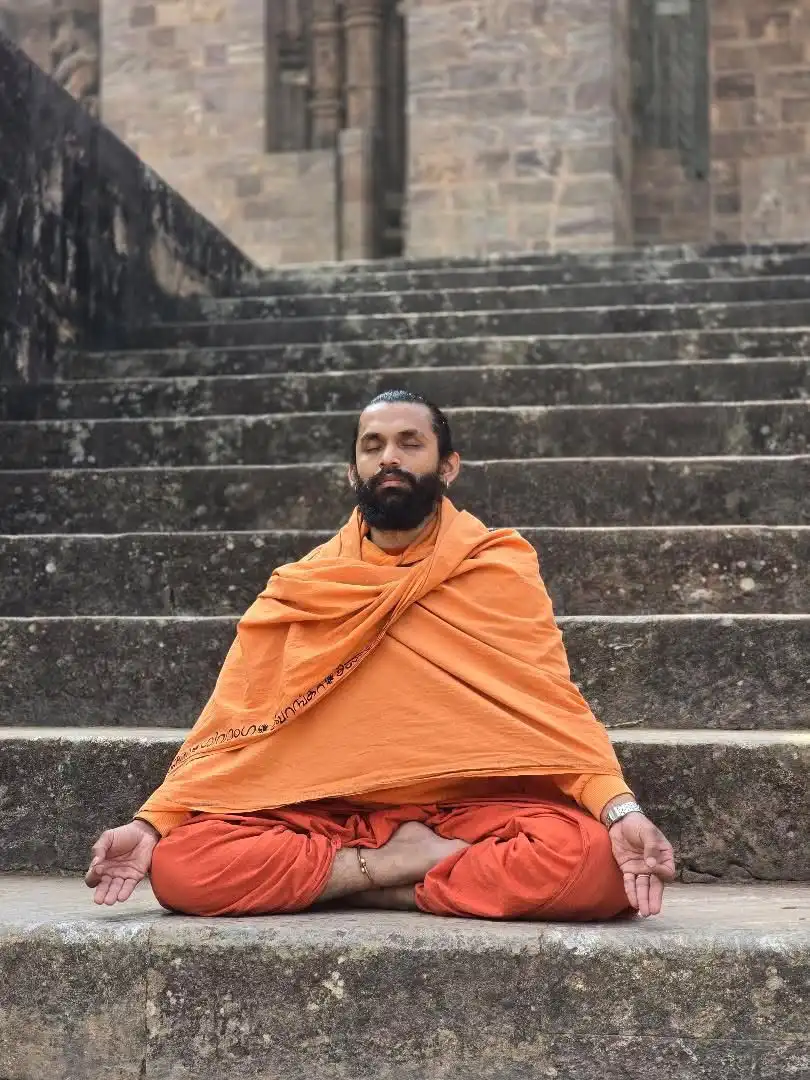
This is exactly why the seat matters so much. When the body folds into the full geometry of Siddhasana, every peripheral gate closes at once: the lower heel pins the perineum against the Swayambhu Lingam, the upper heel locks the pubis, the folded knees shut the hinges, and the hands in Jnana Mudra close the circuit of the palms back into the thighs. The peripheral universe switches off. The current has nowhere left to go but up. (For why the seat itself is a technology and not just a posture, see The Power of Kandasana.)
The engine: Kanda compression, the solar blockade, and the inversion of Apana
A sealed tower is not enough. Something has to drive the current up the shaft. That driver is built in the belly, at the Kanda.
The Kanda is an egg-shaped nerve-center described as sitting roughly nine finger-breadths above the perineum and two below the navel, near the solar plexus where the major nadis take root. It is the clearing-house of Apana Vayu, the heavy downward force. To send that force upward instead of down, the Goraksha Samhita prescribes thermodynamic compression - and the lever it uses is the balance between the two side-channels.

- Pingala, the right channel, is solar, hot, katabolic - the fuel of outward action and muscular heat.
- Ida, the left channel, is lunar, cool, anabolic - the channel of internalization, receptivity, and deep stillness.
The method the texts point to is counter-intuitive: shut the solar channel during intense physical output. When a practitioner locks Pingala and breathes only through Ida while the body is under real load, the muscular system is denied its usual solar fuel. Movement has to be carried less by gross contraction and more by Sukshma Prana, the subtle field. And because the solar vent is closed, the heat generated by the effort cannot escape the normal way. It collects directly at the Kanda, while the long, slow lunar breath opens a vacuum in the chest and skull above.
Now the geometry does its work. The downward Apana, finding its lower gate sealed and its solar escape blocked, pressurizes at the Kanda and undergoes a phase change. The internal fire (Yogagni) cooks the dense, heavy current into something volatile and fast - and the vacuum overhead draws it violently upward. The heavy current that has fallen your whole life turns around and rises. (This is the same inversion mapped, from the angle of the channels, in The Alchemy of the Split Channel: Nadi Shodhana.)
The posterior piston: T7-T8 and the rupture of the heart-knot
The inverted Apana rises out of the navel and immediately meets its first wall: the Bana Lingam, the heart vault. Here the advanced binding postures - legs drawn behind the back, feet locked together, the rib cage compressed from every side - turn the chest into a hydraulic press.
The T7-T8 vertebrae are the mechanical pivot of the mid-back and the posterior anchor of the diaphragm. When a deep binding posture straightens and loads this segment, the thoracic cavity is squeezed into a vice:
- The rising current is trapped. It cannot spread sideways, because the ribs are bound by the limbs. It cannot fall back down, because the pelvic floor is locked.
- Caught between these limits, the Prana and inverted Apana gather into a dense, localized ball of pressure right at the heart center - a bubble that swells with every micro-breath.
The pressure builds until it forces the thoracic spine to straighten with almost mathematical precision, and the strain cracks open the Vishnu Granthi, the heart-knot of personal history and emotional self-preservation. When that knot gives, the bubble does not simply dissipate - it fires up the narrow corridor of the throat with real hydraulic velocity, aimed at the base of the skull.
Inverted Apana rises → caught and compressed at T7-T8 → the heart-knot ruptures → the charge is launched up the throat toward the skull base. (The piercing of the three granthis, base to brow, is treated in full in The Alchemy of the Split Channel: Kaivalya Kumbhaka.)
The cranial intersection: the C1 facet, Shambhavi, and the Khechari vacuum
When the surging current passes the throat it reaches the true gateway of the head: the C1 (Atlas) and C2 (Axis) vertebrae at the suboccipital junction, the mechanical floor on which the brainstem rests. The Goraksha Samhita treats this hinge as a crucial pivot, and modern anatomy agrees from its own side - the suboccipital triangle here carries one of the highest densities of stretch-receptors (muscle spindles) anywhere in the body. It is a place the nervous system listens to with extraordinary sensitivity.
This is why Shambhavi Mudra - the eyes converged and lifted toward the brow, the gaze locked inward - is not a facial expression. The fine pull of the eye muscles sends an immediate reflex down into the deep rectus capitis muscles at C1-C2. The suboccipital triangle releases and opens, the deep fascia of the neck and the tentorium cerebelli draw taut, and the small mechanical kink where the cord meets the brainstem smooths out. The channel straightens, and the pressurized cerebrospinal fluid and the Prana-Spanda current can shoot cleanly up into the ventricles of the brain.
Simultaneously, Khechari Mudra - the tongue turned back behind the soft palate into the nasopharyngeal space - applies a direct vacuum to the upper respiratory vault. Running from the throat up behind the ears are the Eustachian tubes and the paths of the glossopharyngeal and vagus nerves; the negative pressure travels up these tubes and exerts a fine inward-and-downward pull on the sphenoid bone at the skull base. And the sphenoid is precisely the bone that cradles the sella turcica and the pituitary.
So the upper vault is worked from two directions at once - the eye-lock pulling from the front, the throat vacuum pulling from below - and the pituitary-pineal complex deep in the Cave of Brahma is rhythmically massaged between them. This is the mechanical face of what the texts call the release of Amrita, the cooling lunar nectar that begins to seep down from the head. (For Khechari as the seal that closes the cranial circuit and catches that nectar before the navel fire can burn it, see The Architecture of the Electric Body: The Kevala Path.)
The metopic seal: when the skull re-sculpts its own scaffold
The forehead is built from the frontal bone, which in early childhood is split down the middle by the metopic suture, a vertical seam that normally fuses solid. But bone is living tissue. Under Wolff's Law, it remodels its density and shape along the lines of chronic mechanical stress.
The tradition holds that when high charge is run through the Tri-Lingam stack over years, three forces converge on that old seam:
- Hydraulic pressure from within. The upward inversion of Apana, driven by the thoracic piston, pushes cerebrospinal fluid forward into the frontal chambers, a steady outward press from inside the skull.
- Fascial contraction from without. The relentless inward-and-upward pull of Shambhavi tightens the frontalis muscle and the dense scalp fascia (the galea aponeurotica), compressing the outer face of the bone.
- Shear along the old seam. These opposed forces concentrate as shear stress right along the vertical line of the metopic suture, directly over Ajna.
The reported result is a slow physical remodeling: the center of the forehead along the old seam sinks into a faint vertical dent or flattening - the tradition's Chappata - while the bone immediately beside it firms and rises into a subtle vertical, egg-shaped ridge. This is described as the physical emergence of the Siro Lingam itself: the skull re-sculpting its own scaffold to hold the expanded Akasha of a hyper-active frontal lobe. The forehead becomes the visible stamp of the inner pillar.
I want to be careful here, because this is the strongest physical claim in the whole map, and I treat it honestly in the section below. Whatever the bone does or does not do, the pressure at the brow is unmistakable, and it is that pressure, not the cosmetic detail, that matters to the practice.
The external catalyst: forced entrainment in consecrated vortices
Everything so far can be cultivated in isolation, on your own seat, over years. But the same process can be jumped forward violently when the practitioner walks into a space that has been deliberately built or charged to function as a permanent macro-battery - a place where a vast field of stable Spanda is anchored into the ground itself. When a sadhaka with a cleared Tri-Lingam axis enters such a field, the internal system stops behaving like an isolated circuit and falls into entrainment with the space.

Three places taught me this directly.
Alandi: the Ida collapse into Kaivalya Kumbhaka


The Sanjeevan Samadhi of Sant Dnyaneshwar Maharaj at Alandi is an anchored vortex of pure stillness - Sattva and Chitta-Akasha held in place for centuries. I came to it after a long stretch of self-directed Kandasana and inner Kriya, with the central path not yet fully open, having brought the system into deep receptivity by closing Pingala and breathing only the lunar Ida.
The stillness of Mauli's Samadhi acted like an immense magnet. The moment I bowed and brought the C1-C2 gate at the base of my skull close to the tomb, the external field matched the internal Ida vacuum exactly. The need for atmospheric breath dropped to zero - the inner and outer pressures equalized, and the air simply stopped moving at the nostrils. The system was drawn, by induction, straight into Kaivalya Kumbhaka, the spontaneous breathless suspension, and the inner Lingams stood revealed without any effort of mine. The space jump-started the Kriya for me. (For what that suspension is, and why it cannot be manufactured, see the Kaivalya Kumbhaka post.)
The Velliangiri Seventh Hill: the tongue-stone and the unstruck Aum

The seventh peak of the Velliangiri Mountains - the Dakshin Kailash - marks where Sadguru Sri Brahma is said to have shattered his physical frame and projected his life-force out through the crown. The great raw stone that juts over the cliff there, like a protruding tongue, stands as a monument to that exit.
For a long time I had sought the Anahata Nada, the cosmic hum of Aum, and found only the subtler cricket-like buzzing the texts call bheen. The breakthrough needed the thinning of the body itself. I approached the seventh hill alone, at night, four days into a fast, the physical defenses broken down by the climb, Pingala shut, the body running on Sukshma Prana until it felt completely transparent.

As I neared the stone on the left of the temple, the immense charge of that exit-field gripped the three Lingams - pelvic base, T7-T8 vault, cranial vault - and forced them into perfect alignment. When three Lingams line up with zero friction, the Sushumna flashes into full conduction. The Aum that broke over the whole being was not imagined and not subtle - it was a massive, bone-conducting boom running up the Merudanda, matching the frequency anchored into that cliff. It returned on three separate pilgrimages to the peak, which is the only reason I trust it as more than a single overwhelmed night.
Girnar: the vertical spine of Dattatreya

Girnar is a sheer granite spine rising straight out of the plain, capped by the wild presence of Guru Dattatreya's Padukas. Climbing its thousands of stone steps is a structural assault on the skeleton. I climbed it carried almost entirely by the internal rhythm of the Aum, Pingala closed, the Apana cooked at the Kanda and pumped up through the T7-T8 piston with every step. The mountain itself behaves like one tall vertical Lingam; by matching my inner spinal stack to the stone's verticality, the muscular effort fell away, and the climb sustained itself on a continuous, breathless, high-voltage awareness across the whole jagged range.
What is metaphor, and what is felt
A note of honesty, because the language in this post runs as hot as anything in the series, and some of the claims here are physically extreme.
The "magnetic architecture," the body as a "hydraulic matrix," the skull "re-sculpting its scaffold," the consecrated sites as "macro-batteries" charging the yogi by "wireless induction," the binding posture "narrowing the aorta" - these are a working model, a way of organizing felt experience into something teachable. They are not measured physiology. No instrument has recorded Pranavritti, induction from a tomb, or a forehead remodeling under pranic pressure. The metopic dent in particular I offer as the tradition reports it and as I have felt the pressure of it - not as something I am asking you to expect in a mirror, and certainly not as a goal to chase. Wolff's Law is real; the specific claim that years of Shambhavi carve a visible Siro Lingam into the frontal bone is the tradition's interpretation laid over it, and it should be held lightly. Treat every mechanism in this post as scaffolding for understanding, not as settled fact.
What is not metaphor is the experience. The spontaneous arrest of the breath at Alandi was real and unmistakable - the moment the lungs simply stopped asking. The packed heat at the navel under the solar blockade is real. The bubble of pressure at the heart and the straightening of the mid-back are real and specific. And the Aum at Velliangiri - the bone-conducting boom that came three times in the same place - was the most real of all, and it did not feel like a metaphor while it was happening. Trust the sensations. They are the data. Hold the model lightly.
Staying grounded: the cost of skipping the foundation
This is potent material, and the conditions that produced these breakthroughs are dangerous when imitated directly. Read these as non-negotiable.
- Do not engineer the extremes. A four-day fast combined with single-nostril breathing and the climbing of thousands of steps is not a technique to attempt. Held wrongly, that combination is a route to collapse, electrolyte crisis, and worse - not to Samadhi. What arrived for me arrived as a by-product of years of clean practice, in a body that had slowly been made ready. The fast did not cause the Aum; a decade of preparation did, and the fast only thinned the last veil.
- Earn the suspension; never clamp it. Kaivalya Kumbhaka must arrive on its own. A breath squeezed into stillness is strain wearing the costume of stillness. Years of plain Nadi Shodhana come first.
- Build the base before you charge it. The Kanda will not safely give up its charge if the pelvis is locked and dry. Daily grounding asana, hip openers, long holds for the legs and pelvis - these come before any attempt to invert Apana, or what rises will scatter into agitation instead of rising clean.
- Do not chase the markers. Not the dent, not the buzzing, not the boom. The forehead, the bheen, the Aum - these are milestones the body reaches when the channel is clear, not targets to force. Chasing them is the fastest way to wire yourself sleepless, hollow, and grandiose.
- Clean diet, deep sleep, a living teacher. Higher conductance needs a stable system and a guide who can actually see you. If you finish practice scattered, wired, or empty, the foundation is too thin for the current. Step back to the simple breath and let it reset.
A good order for the path
Walking toward this honestly means the same patient sequence the rest of the series lays out, and not jumping its rungs:
- Establish daily Nadi Shodhana and Ujjayi until the breath is long, smooth, and quiet.
- Build the seat. Make Siddhasana (or Siddha Yoni Asana) effortless, so the peripheral gates close on their own and the base stays sealed for long sittings.
- Learn Mula, Uddiyana, and Jalandhara Bandha, then a stable Agnisara and Nauli, until the abdominal vacuum that compresses the Kanda is reliable.
- Add short Antar and Bahya Kumbhaka only once the breath is calm and strain-free.
- Let the balance of the channels mature - the cooling of Ida, the banking of Pingala - under guidance, never by forcing a blockade in a depleted body.
- Allow retention to ripen, by itself, into genuine Kaivalya Kumbhaka. Never manufacture it.
- Introduce the upper seals last - Nabho Mudra first, then Khechari when the tongue is genuinely ready, then the Shambhavi convergence - when the channel can hold the charge without scattering it.
Each stage prepares the system for the next. Every step skipped has to be returned to later, usually after the body breaks down and asks for it.
An invitation to the architecture within
The territory mapped here - the Tri-Lingam stack, the lockdown of the seat, the inversion of Apana through Kanda compression, the thoracic piston, the seals at the skull base, and the alignment that lets the central channel finally sound - is the deep structural core of the upcoming Sadhana Yog Immersion. The earlier posts taught how to clean the channel and how to charge it. This is the architecture all of that charge is finally for.
We are not learning to be flexible, and not even to breathe better. We are learning to read the body as the pressurized temple it is, to seal its gates, and to stand the three pillars in a single line.
A question to leave you with
When you sit tomorrow morning, fold into your seat and feel for the gates - the soft drain at the base, the radiating openness of the palms and knees, the busy outward pull of the eyes. Then let them close, one by one, and notice what happens to the current when it has nowhere left to leak. Most of us spend an entire practice life venting quietly out of the periphery and never feel the column that waits down the center once the leaking stops.
The mountains at Alandi, Velliangiri, and Girnar were only ever monuments to that column. The temple is built within; the geometry is written into the bones. When the outer stone is no longer needed, all that remains is to seal the base, isolate the channels, flip the tongue, and let the three Lingams lock into their single line - and listen for the sound that was never struck.
Adesh. Adesh. Alakh Niranjan.


